If you’re reading this, there’s a good chance the wind is blowing outside right now and your chimney is making a sound you’ve never noticed before. Maybe it’s a low rattle. Maybe it’s a metallic clang. Maybe it’s a steady whistle that started this fall and hasn’t stopped.
The first thing worth saying: most chimney noises in wind are harmless. The second thing worth saying: some aren’t. The trick is knowing the difference.
This guide walks through the common causes, what they sound like, what they mean, and when you should actually pick up the phone.
The Short Version
Chimney noise during wind almost always comes from one of five places: the cap, the damper, the flashing, debris inside the flue, or the chimney structure itself. Cap and damper issues are the most common and usually inexpensive to fix. Flashing and structural issues are less common but more serious.
If the noise is new, getting worse, or accompanied by visible damage outside, it’s worth having someone look. If it’s an occasional rattle in a heavy windstorm and your chimney looks fine from the ground, you probably have time to schedule a routine inspection rather than treating it as urgent.
The Five Most Common Causes
1. A Loose or Damaged Chimney Cap
This is the most common culprit by a wide margin. The chimney cap is the metal cover at the top of your chimney that keeps rain, animals, and debris out. Most caps have a mesh screen and are fastened to the flue with screws or a clamp. Over time, those fasteners loosen, especially on the North Shore and in coastal Vancouver, where salt air accelerates corrosion.
What it sounds like: A metallic rattle, often rhythmic with gusts. Sometimes a single loud bang followed by quiet, then another bang. You’ll usually hear it most clearly from upstairs rooms or on still nights when one strong gust catches the cap.
Why it matters: A loose cap isn’t immediately dangerous, but in a strong enough windstorm it can blow off entirely. Once it’s gone, your chimney is open to rain, birds, squirrels, and embers that can drift onto your roof. We see plenty of caps in the spring that spent the winter halfway across the yard.
What it usually costs to fix: Re-securing or replacing a chimney cap is one of the simpler repairs we do. Most are completed in a single visit.
2. A Damper That Won’t Stay Shut
Your damper is the metal plate inside the chimney that opens and closes the flue. When it’s open, smoke goes up. When it’s closed, cold air stays out. If the damper is damaged, rusted, or no longer seating properly, wind can catch it and push it around, which produces a clatter that sounds like it’s coming from inside the wall.
What it sounds like: A muffled banging or clattering, usually from inside the firebox area rather than up at the roof. You may also feel a draft coming down the chimney on windy days even when the damper is “closed.”
Why it matters: A damper that won’t seal isn’t dangerous, but it’s costing you money in heating bills all winter. It’s also a sign the damper hardware is at end of life and worth replacing, especially before a really cold snap.
What to check: Open and close your damper from inside the fireplace. If it doesn’t move smoothly, doesn’t fully close, or makes scraping noises, the damper is the likely source.
3. Loose Flashing
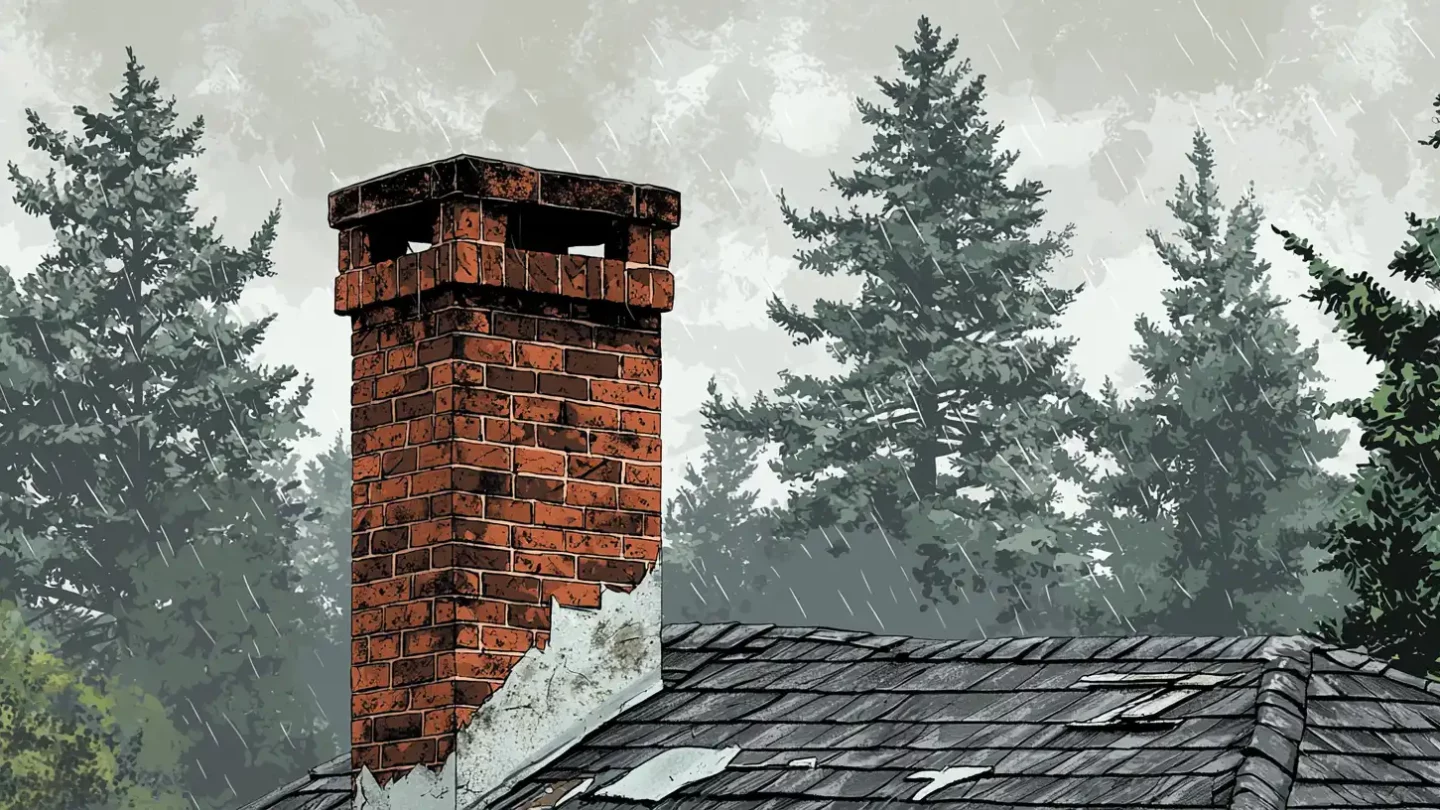
The flashing is the metal sheeting that seals the gap where your chimney meets the roof. It’s nailed and sealed in place, but the nails work loose over time, and the sealant cracks, especially after a few BC winters of freeze, thaw, rain, and wind.
What it sounds like: A flapping or thumping noise, often heard from the attic or upstairs ceiling more than from outside. Sometimes a tinny vibration that builds with stronger gusts.
Why it matters: This one matters more than people realize. Loose flashing isn’t just a noise problem, it’s a leak waiting to happen. Water that gets behind flashing runs down the chimney structure, into the attic, and onto your ceiling. By the time you see a stain on the ceiling, the damage in the attic is usually significant.
If you’ve had any roof leaks near the chimney, ceiling stains in the room with the fireplace, or noticed missing or curled-back metal at the chimney base when you’ve looked up at the roof, the flashing is worth getting checked sooner rather than later.
4. Debris Inside the Flue
Birds nest in chimneys. Squirrels do too. So do raccoons, occasionally. Branches break off in windstorms and fall in. Leaves and needles accumulate, especially under tall conifers in older Vancouver neighbourhoods. When wind moves through a flue with debris in it, the debris moves around and you hear it.
What it sounds like: Scratching, scrabbling, or shuffling sounds from inside the chimney itself. Sometimes high-pitched chirps if you’ve got nesting birds. Light rustling on windy days that wasn’t there before.
Why it matters: A blocked or partially blocked flue is a real safety issue. It restricts draft, which means smoke can back up into the house. If you’ve got an active bird’s nest, it’s also a fire hazard the next time you light the fireplace. Anything blocking the flue needs to come out before you use the chimney.
What to do: If you can hear movement that sounds like an animal, don’t light a fire. Get the chimney inspected and cleared first. If it’s just a “something’s in there” rustle and you haven’t used the fireplace recently, a sweep will identify and clear it.
5. Structural Issues
This is the one to take seriously when it applies. Older masonry chimneys, especially the brick chimneys on pre-1960s Vancouver homes, develop cracks in the mortar over decades. The crown at the top can crack and let water in. Bricks can spall, loosen, or shift. In severe cases, the upper portion of the chimney can lean.
A structurally compromised chimney can rattle in wind because pieces of it are actually moving against each other. That’s different from a cap or damper rattle, and it’s not a noise to ignore.
What it sounds like: A deeper, lower-frequency sound, more of a groan or grind than a metallic rattle. Sometimes accompanied by small bits of mortar or brick fragments appearing in the firebox or on the roof.
Why it matters: A leaning or compromised chimney can come down in a strong enough storm. Even before that, the cracks and gaps that produce the noise are letting water into the structure, which accelerates the damage.
What to look for:
- Visible cracks in the mortar joints when you look up at the chimney from the yard
- Bricks that look loose, bowed, or have shifted out of line
- Mortar dust or brick fragments inside the fireplace
- A chimney that visibly leans, even slightly
- Stains running down the brick face below the crown
If any of these are present along with the noise, get an inspection booked. This is the category of problem that gets cheaper to fix the sooner you catch it.
When to Call Someone
Here’s a straightforward way to think about it.
Schedule a regular sweep or inspection (not urgent) if:
- The noise is occasional and only in heavy wind
- Your chimney looks fine from the ground
- You haven’t had it inspected in the last couple of years anyway
- You haven’t used the fireplace yet this season
Get it looked at sooner if:
- The noise is new this fall and you’re hearing it more
- You’ve noticed mortar bits, brick fragments, or water stains
- The damper isn’t sealing properly
- You’re planning to use the fireplace soon and you’re not sure what’s making the noise
Don’t wait if:
- You can hear something moving (animal) inside the flue
- You’ve seen actual chimney pieces on the roof or in the yard
- The chimney visibly leans or has new cracks you can see from the ground
- You’ve had ceiling stains or attic moisture near the chimney
What an Inspection Actually Involves
If you do call someone, here’s what to expect from a competent chimney inspection. A standard Level 1 inspection checks the readily accessible parts of the chimney inside and out, the cap, crown, flashing, exterior masonry, damper, firebox, and the visible portion of the flue. A Level 2 inspection adds a video scan of the inside of the flue and is typically required when a home is being sold or when there’s been an event like a chimney fire or earthquake.
For a noise diagnosis, Level 1 is usually enough. The technician should be able to identify the source within the first ten or fifteen minutes of the visit, give you a straight answer about what it is, and quote what fixing it involves.
Look for someone who is WETT-certified, that’s the certification BC insurers and home inspectors recognize, and it’s the credential that means the technician has been trained on the specific standards that apply here.
The Honest Bottom Line
Chimney noise in wind is one of those household problems that’s almost always less serious than it sounds, and occasionally more serious than it sounds. The variation is too wide to diagnose from a search result.
If you’ve read through the five common causes and one of them clearly matches what you’re hearing, you’ve got a starting point. If the noise is new, getting worse, or paired with anything visible, the right move is to get someone up there.
Lindbjerg Chimney has been working on Lower Mainland chimneys since 2013. We’re WETT-certified, we work across Vancouver, the North Shore, Burnaby, the Tri-Cities, Surrey, Langley, and the Fraser Valley, and we’ll give you a straight answer about whether what you’re hearing is a simple fix or a more serious repair, without trying to sell you on either one.
If you want it looked at, call us at 604-614-7516 to book an inspection. If it can wait until your next routine sweep, we’ll tell you that too.
Have a chimney concern that doesn’t quite match what’s described above? Get in touch, we’d rather answer a quick question than have you worry about it through the next windstorm.